Become a Trusted Financial Leader with CPA
When it comes to accounting prestige, no credential commands more global respect than the U.S. Certified Public Accountant (CPA) license. Issued by the American Institute of Certified Public Accountants (AICPA) and administered through NASBA, the CPA is the benchmark of accounting excellence in the United States — and increasingly, around the world.
For finance and accounting professionals aiming to work with Big 4 firms, multinational corporations, or U.S.-based financial institutions, the CPA is the single most powerful credential you can hold. It validates your expertise in auditing, financial reporting, tax, and business law at the highest level.

What Is the CPA?
The U.S. CPA (Certified Public Accountant) is the highest-level professional accounting license in the United States, regulated by each U.S. state's Board of Accountancy and administered by the AICPA (American Institute of Certified Public Accountants) and NASBA (National Association of State Boards of Accountancy).
Often described as the U.S. equivalent of the CA (Chartered Accountant) qualification, the CPA is one of the most rigorous and highly regarded accounting certifications in the world. CPAs are authorized to sign audit reports, represent clients before the IRS, and practice public accounting — powers no other accounting credential grants in the United States.
Why Pursue the U.S. CPA?
The CPA is not just a credential — it's a career-defining milestone that opens doors that remain closed to non-CPA professionals:
Global brand recognition: The CPA is recognized by employers in the U.S., India, Middle East, Southeast Asia, and globally as the gold standard in accounting.
Big 4 access: The CPA is often a requirement or strong preference for roles at Deloitte, PwC, EY, and KPMG.
Premium compensation: CPA-holders command significantly higher salaries than non-certified peers at every career stage.
Exclusive legal authority: Only CPAs can sign audited financial statements and represent clients before the IRS in the U.S.
Career versatility: The CPA qualifies professionals for roles spanning public accounting, corporate finance, taxation, forensic accounting, and consulting.
U.S. job market access: For professionals seeking careers or work authorization in the United States, the CPA is one of the most effective credentials to hold.
Who Should Pursue the CPA?
The CPA is a versatile credential suited to a wide range of accounting and finance professionals:
CPA Exam Structure
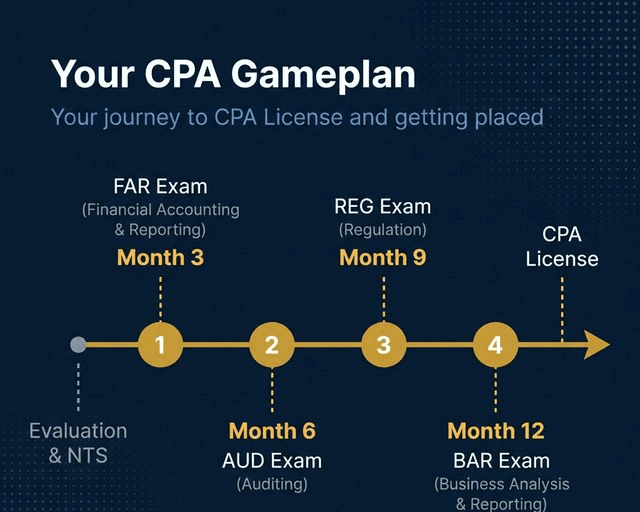
The CPA Exam was significantly restructured in 2024 under the CPA Evolution initiative. The new exam consists of 3 core sections (mandatory for all candidates) plus 1 discipline section of your choice:
| Exam Section | Key Topics | Type |
|---|---|---|
| AUD — Auditing & Attestation | Ethics, professional responsibilities, auditing standards, evidence, reporting | Core (Mandatory) |
| FAR — Financial Accounting & Reporting | U.S. GAAP, IFRS, government & nonprofit accounting, financial statements | Core (Mandatory) |
| REG — Taxation & Regulation | U.S. federal taxation, ethics, business law, individual & entity taxation | Core (Mandatory) |
| Choose 1: BAR / ISC / TCP | Business Analysis & Reporting (BAR) | Information Systems & Controls (ISC) | Tax Compliance & Planning (TCP) | Discipline (Choose 1) |
Each section is scored on a scale of 0–99, with a minimum passing score of 75. Candidates must pass all four sections within an 18-month rolling window.
CPA Eligibility Requirements
CPA eligibility requirements vary slightly by U.S. state. The typical requirements are:
Education | A minimum of 120 credit hours (bachelor's degree equivalent) to sit the exam. Most states require 150 credit hours (typically a master's degree or additional coursework) to obtain the CPA license. |
Accounting Credits | Typically 24 semester hours in accounting subjects and 24 hours in business-related subjects (varies by state). |
Work Experience | Generally 1–2 years of supervised accounting experience under a licensed CPA (requirement varies by state). |
Exam | Pass all 4 sections of the Uniform CPA Examination (3 core + 1 discipline) within an 18-month window. |
Ethics Exam | Many states require passage of the AICPA Ethics Exam as a final step before licensure. |
Career Pathways with a CPA
The CPA opens access to some of the most coveted roles in the accounting and finance world:
CPA vs. CA — What's the Difference?
Many professionals from countries with CA traditions wonder how the CPA compares. While both are prestigious accounting credentials, they differ in scope and jurisdiction:
| Factor | U.S. CPA | CA (India/UK/etc.) |
|---|---|---|
| Issuing Body | AICPA / NASBA (U.S.) | ICAI, ICAEW, etc. |
| Primary Focus | U.S. GAAP, tax, auditing, reporting | Local GAAP, audit, tax, law |
| Global Recognition | Strongest in U.S. & MNCs globally | Strong in home country + Commonwealth |
| Exam Structure | 4 sections (3 core + 1 discipline) | Multiple stages (Foundation to Final) |
| Time to Complete | 12–18 months (for qualified candidates) | 3–5 years typically |
| U.S. Career Access | Direct access with MRA agreements | Limited without additional conversion |
Your U.S. CPA Journey Starts Here.
At The Chartered Academy, we specialize in helping accounting professionals from across the globe earn their U.S. CPA license. Our structured preparation program covers all four exam sections with expert instruction, adaptive practice tools, and dedicated support from experienced CPA mentors. Whether you're a CA, ACCA, or fresh graduate, we'll guide you every step of the way — from eligibility evaluation to exam day and beyond.
Why Choose Our CPA Program?
Comprehensive 4-part exam preparation. Duration: 12-18 Months. Format: Adaptive learning modules, live expert Q&A, and extensive question banks. Expert Instructors: Leading experts dedicated to mastering the art of professional exam preparation.
Begin Your CPA Course With TCA ?
Step into global career and leadership opportunities
Register for the AI-Ready CPA Webinar
Other Courses You Might Like
Expand your expertise with our other industry-leading programs.

CMA (Certified Management Accountant)
The CMA certification is globally recognized for professionals excelling in financial planning, analysis, control, and strategic decision-making.

CIA (Certified Internal Auditor)
The Certified Internal Auditor (CIA) designation is offered by the Institute of Internal Auditors (IIA) and confirms your knowledge in internal audit, risk management, and control.